
Tungsten copper (WCu) electrodes & components.
Carbide India manufactures tungsten copper (WCu) — tungsten grains homogeneously embedded in a conductive matrix of high-purity copper — as EDM electrodes, switchgear contacts, rigid bars and balancing parts, made to your drawings in four grades from W60 to W80.
- 04
- WCu grades
- W60–W80
- Tungsten content
- 30–50%
- Conductivity, IACS
- 15.6
- Max density, g/cm³
- To drawing
- Electrodes, contacts, bars
01 — Applications
Where a part must conduct like copper and endure like tungsten.
We developed the process of embedding tungsten grains evenly in high-purity copper. These are the parts it goes into.
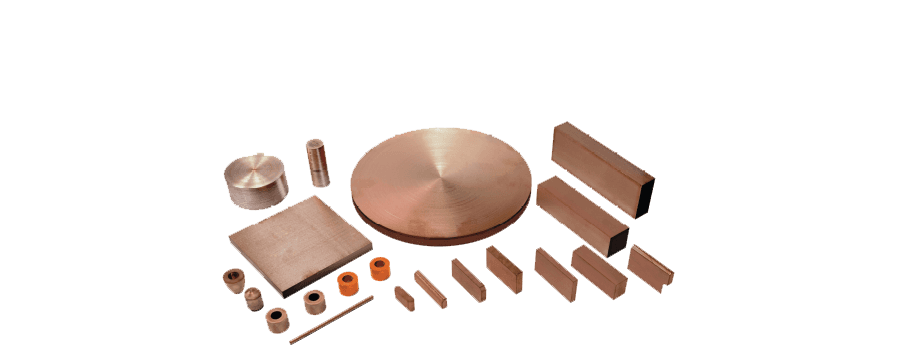
WC/01
EDM electrodes
Electrodes that erode slowly and hold detail over long burns — the electrode of choice for spark-eroding cemented carbide.
WC/02
Switchgear electrical contacts
Contacts that survive repeated arcing without welding shut or eroding away — for breakers and contactors.
WC/03
Rigid bars & boring bars
High density and stiffness damp chatter and resist deflection in long-reach tooling.
WC/04
Fuselage mass balancing & counterweights
Dense, machinable weights for aerospace balancing where space is tight.
WC/05
Riveting dollies & bucking bars
Heavy, compact backing tools that absorb rivet blows without bouncing.
WC/06
Vibration damping & dynamic balancing
Mass placed exactly where it's needed to tune or balance rotating and vibrating parts.
02 — Composition
Every 10% of tungsten is a trade.
Add tungsten and the part gets harder, denser and more resistant to arc erosion. Add copper and it conducts better. Four grades, from W60 to W80, sit along that line.
← More copper: conducts
More tungsten: endures →
T-60
W60 / Cu40
T-70
W70 / Cu30
T-75
W75 / Cu25
T-80
W80 / Cu20
Conductivity
% IACS
40–50
38–45
35–42
30–38
Hardness
HV30
130–175
150–210
180–230
210–270
Density
g/cm³
13.0–13.7
13.8–14.6
14.6–15.0
14.8–15.6
Published ranges · conductivity relative to 100% IACS = 0.58001 /Ω·cm
03 — EDM electrodes
Graphite, copper or tungsten copper?
Each electrode material wins a different job. Where tungsten copper earns its higher price.
| Electrode | Best at | Trade-off | Choose it when |
|---|---|---|---|
| Graphite | Roughing and high removal rates, with low relative wear; tolerates heat in the spark gap | Weaker on fine finishes and sharp detail, where its relative wear climbs | You're roughing large cavities in steel |
| Copper | Fine finishes and small, sharp detail | Wears faster than tungsten copper in demanding burns | You're finishing steel to a low surface roughness |
| Tungsten copper | Excellent wear resistance; regarded as the best metallic electrode for EDM of carbide | Harder to machine and costlier than copper | You're eroding cemented carbide or another hard material, or electrode wear is costing you accuracy |
General EDM practice. Actual wear depends on grade, current, pulse settings and polarity — run a test burn with your own parameters.
04 — Made to drawing
Specified by you. Machined like a metal.
WD/01
To your drawing
Our tungsten copper alloys are manufactured specially to customers' drawings and specifications — not cut from a catalogue bar.
WD/02
Conventional machining
WCu machines by turning, milling, drilling or grinding — so finished electrodes and contacts can be made in an ordinary toolroom.
WD/03
Dense and rigid
High density and a high modulus of elasticity make it the right material for rigid boring bars and counter-balancing weights.
Why WCu matters more as the world electrifies: tungsten copper, explained.
05 — Questions
Asked by toolrooms and engineers.
Grades, EDM, machining and made-to-drawing parts.
Q/01Which tungsten copper grade should I choose?
More tungsten (T-75, T-80) gives higher hardness, density and arc-erosion resistance; more copper (T-60, T-70) gives higher electrical conductivity — from 30–38% IACS at W80 up to 40–50% at W60. Tell us the application and we'll recommend a composition.
Q/02Do you make tungsten copper parts to drawing?
Yes. Our tungsten copper alloys are manufactured specially to customers' drawings and specifications — electrodes, contacts, bars, dollies and balancing parts.
Q/03Can tungsten copper be machined?
Yes. It is machinable by conventional metal-removal techniques — turning, milling, drilling or grinding.
Q/04Why use tungsten copper electrodes for EDM?
Tungsten copper erodes far more slowly than pure copper, so it holds detail over long burns. It is suited to spark-eroding hard materials like cemented carbide, giving maximum electrode life and minimum downtime.
Q/05Is tungsten copper better than graphite for EDM?
For different jobs. Graphite is the usual choice for roughing large cavities in steel; copper for fine finishes. Tungsten copper wears far less than either in demanding burns and is widely regarded as the best metallic electrode for EDM of cemented carbide — at a higher cost and with harder machining.
Further reading
RFQ — 24 h engineering response
Send us your
hardest problem.
Share a drawing, a failing part, or a duty cycle. Our application engineers reply within 24 hours with DFM feedback, a grade recommendation, and a technical quote.
Trusted by Bosch · HAL · Atlas Copco · SECO · Jindal Stainless and more