
Tungsten carbide dies & die inserts for metal forming.
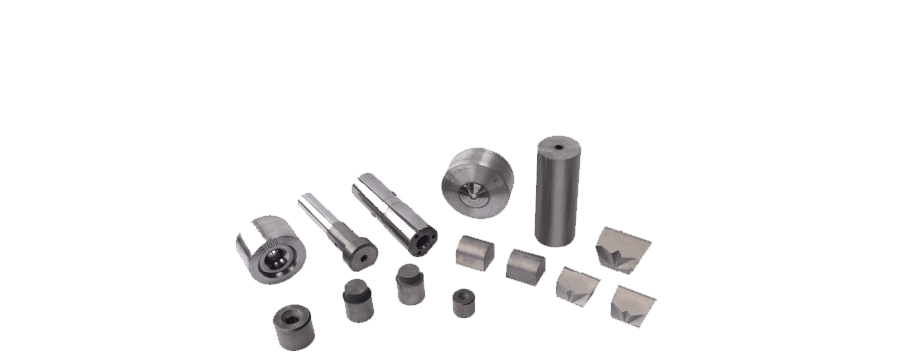
Carbide India manufactures tungsten carbide dies and die inserts for metal forming — cold heading pellets, wire, bar, tube and deep drawing dies, coining dies and punches, and forming rolls — in grades matched to the impact and wear of each forming process.
- 04
- Forming grades
- Up to 25%
- Cobalt — CID25
- 82.5–91
- HRA across the range
- Pre-ground
- Heading pellets
- Sub-micron
- Grade options
01 — Range
Tooling that moves metal, millions of strokes over.
From fastener heading to coin minting and wire drawing — the carbide at the working face of every forming line.
FM/01
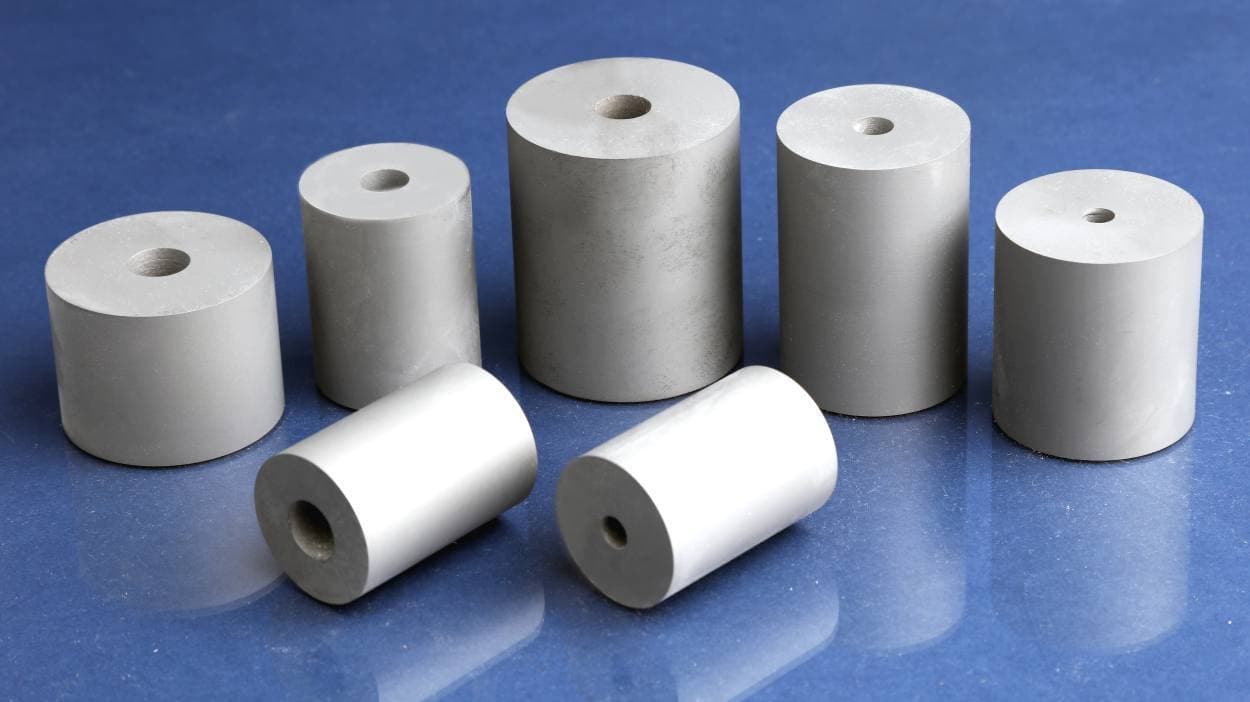
Cold heading pellets & die inserts
Carbide pellets and nibs — the die inserts at the heart of heading and drawing dies — supplied pre-ground, in standard and special sizes, in grades up to impact-tough CID25 and sub-micron options.
FM/02
Forging dies — nails, screws, rivets & steel balls
Tooling for high-volume fastener and ball forming, where every stroke is a blow.
FM/03
Wire & bar drawing dies
Drawing dies in CIW08 and CID14 that hold their bore size over long drawing runs.
FM/04
Deep drawing, can & tube drawing
Dies and drawing plugs for deep-drawn parts, cans and tubes — including deep drawing for ordnance factories.
FM/05
Coining dies & punches for mints
Tooling that stamps fine detail at very high pressure, coin after coin.
FM/06
Wire straightening & rolls for steel mills
Wear-resistant carbide for straightening lines and rolling mills.
02 — Load map
Every die sits somewhere between a hammer and a file.
Heading takes a blow on every stroke; drawing slides metal through the bore all day. Where your tool sits on this map decides the grade.
↑ More impact → more cobalt
→ More wear → finer, harder
Impact →
- Cold heading diesCID25
- Forging — nails, screws, rivets, ballsCID25
- Coining dies & punches
- Deep drawingCID14
- Can & tube drawingCID14
- Bar drawingCID14
- Wire drawing diesCIW08
- Drawing plugsCIF06
Sliding & abrasive wear →
Positions are qualitative. Grades shown are those we publish for each process; for coining tools, tell us the coin alloy and run length and we'll recommend one.
03 — Grades
Four grades for four kinds of punishment.
From wear-resistant CIW08 and extra-fine CIF06 to CID25, the toughest grade we make.
| Grade | WC grain | Cobalt % | Hardness (HRA) | Density (g/cm³) | TRS min (N/mm²) | Typical application |
|---|---|---|---|---|---|---|
| CIW08 | Medium | 8 | 88.5 | 14.68–14.78 | 2,500 | Wear resistance, wire drawing dies |
| CID14 | Coarse | 14 | 86 | 14.05–14.20 | 2,800 | Metal forming — deep, bar, tube and can drawing |
| CID25 | Coarse | 25 | 82.5 | 13.06–13.18 | 2,650 | High-impact parts like heading dies |
| CIF06 | Extra fine | 6 | 91 | 14.88–15.00 | 3,100 | Metal cutting, drawing plugs, shot-blasting nozzles, asbestos sheet cutting |
04 — Casing
Carbide is strong in compression. The case keeps it there.
A forming die's carbide nib is shrunk into a steel case. Get the fit right and the case carries the bursting load; get it wrong and the carbide cracks.
CS/01
Prestress
The nib is made slightly larger than the heated case bore. As the case cools it squeezes the nib into compression — which offsets the tension of metal being forced through the die.
CS/02
Fit quality
An out-of-round or poorly mated fit spreads that squeeze unevenly, and uneven stress is a classic cause of early cracking. The mating surfaces need to be ground true.
CS/03
Heat
Steel expands faster than carbide, so a hot die loses some of its interference. Working temperature belongs in the fit calculation.
General die-design practice. More on choosing grades for forming: carbide dies, explained.
05 — Failure guide
Read the die before you re-order it.
A failed die tells you whether to change the grade, the case or the process.
| What you see | What it means | What to change |
|---|---|---|
| Cracks or chips at the bore entry | Impact is winning | Move tougher: more cobalt, coarser grain — towards CID25 for heading. |
| Bore wearing oversize, or a ring worn into it | Wear is winning | Move harder: less cobalt, finer grain — CIW08 or CIF06 for drawing. |
| Pick-up or galling on the bore | Friction and adhesion, not the carbide | Check the bore finish and the lubrication before changing grade. |
| A crack running along the nib | Lost prestress — the nib is no longer held in compression | Check the case: an out-of-round or under-sized shrink fit leaves the carbide in tension. Re-case with a correct fit. |
| Nib loosening in a hot die | Steel expands faster than carbide, so heat eats the interference | Allow for working temperature when the fit is specified — tell us how hot the die runs. |
General forming-die practice. Send us a failed die and we'll read it with you.
06 — Track record
Forming tooling for work that can't be scrapped.
Coins
Coin manufacture
Our products are used to manufacture coins — fine detail, stamped at high pressure, run after run.
Cartridges
Indian Army
Our products are used to make bullet shell cartridges for the Indian Army — deep drawing where a die out of size means scrap.
Ordnance
Deep drawing dies
Deep drawing dies for ordnance factory work are part of our standard forming range.
07 — Questions
Asked by die shops and buyers.
Grades for heading and drawing, pre-ground pellets, coining and casing.
Q/01Do you make tungsten carbide die inserts?
Yes. Cold heading pellets and drawing-die nibs are die inserts — the carbide core of the die that does the forming. We make them pre-ground, in standard and special sizes, in grades from wear-resistant CIW08 to impact-tough CID25, including sub-micron options.
Q/02Which carbide grade is used for cold heading dies?
CID25 — a coarse-grain grade with 25% cobalt (82.5 HRA, TRS 2,650 N/mm²) — is our grade for high-impact parts like heading dies. It has the highest impact resistance in our range.
Q/03Which grade do you recommend for wire drawing dies?
CIW08 (8% cobalt, 88.5 HRA) for wear resistance in wire drawing. For deep drawing and bar, tube and can drawing we use CID14, which trades a little hardness for more toughness.
Q/04Do you supply heading pellets pre-ground?
Yes. Forming and cold heading pellets are available pre-ground, in various grades including sub-micron, and we accept special-size orders.
Q/05Can you make coining dies and punches?
Yes — coining dies and punches for mints are part of our metal-forming range, and our products are used in coin manufacture.
Q/06Why are carbide dies shrink-fitted into steel cases?
Carbide is very strong in compression but weaker in tension. Shrinking a steel case onto the nib squeezes it into compression, which offsets the bursting stress of metal being forced through the die. An out-of-round or under-sized fit leaves the carbide unsupported and is a common cause of early cracking.
Further reading
RFQ — 24 h engineering response
Send us your
hardest problem.
Share a drawing, a failing part, or a duty cycle. Our application engineers reply within 24 hours with DFM feedback, a grade recommendation, and a technical quote.
Trusted by Bosch · HAL · Atlas Copco · SECO · Jindal Stainless and more