
Tungsten carbide choke beans, stems & seats.
Carbide India manufactures choke beans, stems and seats for oil and gas wellheads — tungsten carbide or 98.5% alumina liners for OCT, Thornhill-Craver, Gray Tool and Cameron type chokes, plus custom flanged positive chokes and flanged and threaded adjustable chokes.
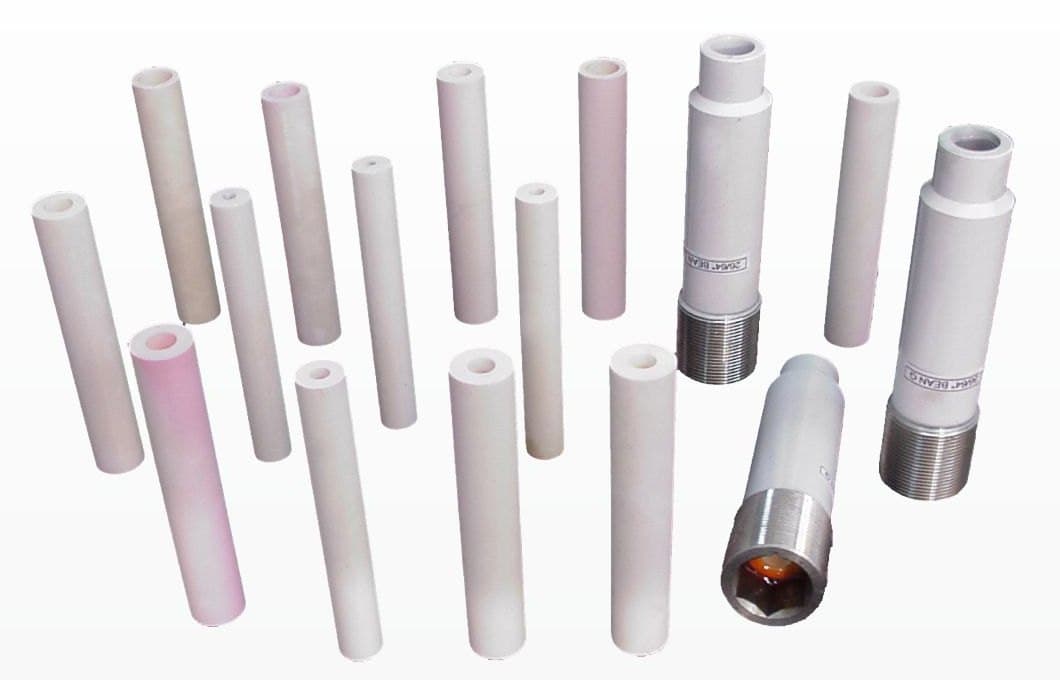
Choke beans — carbide & alumina liners
- 04
- Choke makes matched
- 1/64″
- Orifice sizing
- 5%
- Steps below 14/64″
- WC–10% Ni
- Carbide insert
- 98.5%
- Alumina option
01 — Anatomy
Where the carbide goes in a choke.
A choke controls flow at or near the christmas tree. High-pressure gas and oil carrying sand passes through it at speed — so the parts in the flow path are made of the hardest material that can survive it.
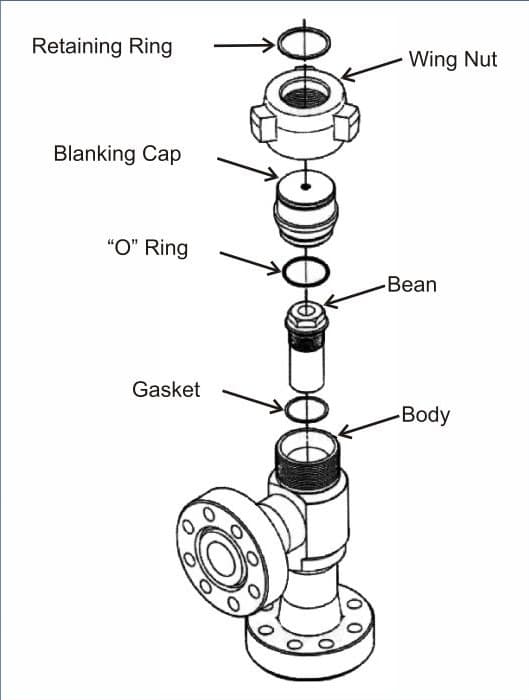
CH/01
Positive choke
A fixed bean sets the flow: the orifice size is chosen before the well flows and can't be adjusted while it does. We make beans for OCT, Thornhill-Craver, Gray Tool and Cameron types, and custom flanged positive chokes.
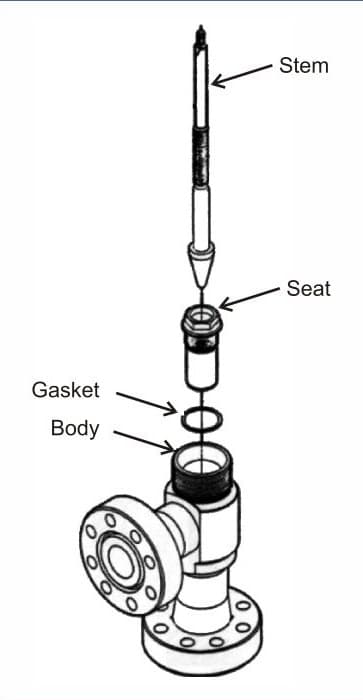
CH/02
Adjustable choke
A stem moves against a seat to vary the opening. We make tungsten carbide and hardened-steel stems and carbide seats, for flanged and threaded adjustable chokes.
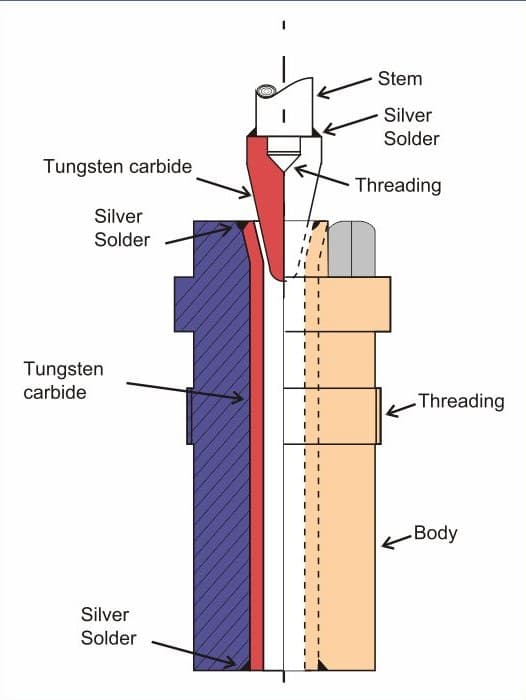
CH/03
Carbide seat & stem
Tungsten carbide is silver-soldered onto the stem tip and lines the seat — exactly where the flow is fastest and the erosion worst.
02 — Orifice sizing
Sized in 64ths. Converted in a click.
Choke beans are identified by orifice diameter in 64ths of an inch. Pick a size to see it in inches, millimetres and flow area.
- 0.2500
- Diameter, inch
- 6.35
- Diameter, mm
- 31.7
- Flow area, mm²
- 0.0491
- Flow area, in²
Doubling the bean size quadruples the flow area — which is why sizes below 14/64″ come in 5% steps for finer control.
03 — Specifications
Stems, seats and inserts, published.
Adjustable choke stems we make, and the properties of our carbide and ceramic inserts.
| Choke type | Stem length | Orifice sizes |
|---|---|---|
| Cameron H-2 | 14 5/8" | 3/4", 1" |
| OCT N-60 & N-62 | 16 3/4" (N-60), 18" (N-62) | 3/4", 1" |
| Thornhill-Craver 894 & 899 | 19 5/8" (894), 24 1/2" (899) | 1/2", 3/4", 1" |
| Gray Tool 8711 | 15 3/8" | 3/4" |
| Property | Tungsten carbide insert | Ceramic insert |
|---|---|---|
| Composition | WC 90% ± 0.1, nickel 10% ± 0.1 | Alumina 98.5% ± 0.1 |
| Density (g/cc) | 14.6 ± 0.1 | 3.75 ± 0.1 |
| Transverse rupture strength (psi) | 290,000 ± 1,500 | 50,000 ± 4,000 |
| Compressive strength (psi) | — | 350,000 ± 10,000 |
| Hardness (R45N) | 78 ± 3 | 80 ± 3 |
| Porosity | — | Nil |
| Colour | Black | White / pink |
04 — Erosion
The hardest-working valve in the well.
Choke valves see some of the highest erosion rates in a production system. Three things decide how long the trim lasts.
ER/01
Velocity
The pressure drop across the choke accelerates the fluid — and every grain of sand in it. Higher exit velocity means faster erosion of everything downstream of the orifice.
ER/02
Material
Tungsten carbide is the standard trim material for most chokes. Our 98.5% alumina is slightly harder; our carbide is nearly six times stronger in bending — far better at surviving shock and handling.
ER/03
Binder
Our choke-bean carbide is bound with 10% nickel, not cobalt. Nickel-bound carbide stands up better to corrosive well fluids while keeping the hardness the sand demands.
General oilfield practice. Bean size and material for a specific well should follow the operator's erosion-velocity criteria.
05 — Questions
Asked by wellsite and procurement teams.
Fit, sizing, carbide vs ceramic and binder choice.
Q/01Which choke types do your beans and stems fit?
We make choke beans to match OCT, Thornhill-Craver, Gray Tool and Cameron types, and stems and seats for Cameron H-2, OCT N-60 and N-62, Thornhill-Craver 894 and 899 and Gray Tool 8711 adjustable chokes — plus custom flanged positive chokes and flanged and threaded adjustable chokes.
Q/02What orifice sizes are available?
Beans are identified by choke diameter in 64ths of an inch and offered in 10% increments. Below 14/64" — between 6/64" and 14/64" — they come in 5% increments for more precise flow control.
Q/03Should I choose a tungsten carbide or ceramic choke bean?
Our ceramic insert (98.5% alumina) is slightly harder, at 80 R45N against 78. Our tungsten carbide insert is far stronger, with a transverse rupture strength of 290,000 psi against 50,000, so it better survives shock and handling. Choose carbide for toughness, ceramic where pure abrasion dominates.
Q/04Why is your choke-bean carbide nickel-bound?
Our choke-bean carbide uses a 10% nickel binder instead of cobalt. Nickel-bound tungsten carbide resists corrosion better in aggressive well fluids, while keeping the hardness needed against abrasive flow.
Q/05How do I convert a choke bean size to millimetres?
Bean sizes are in 64ths of an inch: divide by 64 for inches, then multiply by 25.4 for millimetres. A 16/64" bean is 0.25", or 6.35 mm. Our size converter on this page does it for any size, with flow area.
RFQ — 24 h engineering response
Send us your
hardest problem.
Share a drawing, a failing part, or a duty cycle. Our application engineers reply within 24 hours with DFM feedback, a grade recommendation, and a technical quote.
Trusted by Bosch · HAL · Atlas Copco · SECO · Jindal Stainless and more