
Tungsten carbide mining buttons & inserts.
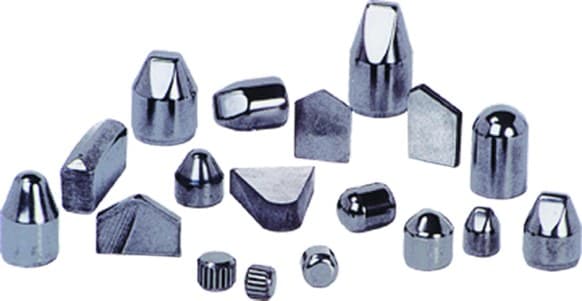
Carbide India manufactures tungsten carbide mining buttons and inserts from our own tungsten powder in Nashik — five button shapes in 96 standard sizes, plus octagonal and square inserts and auger tips, in a dedicated series of mining grades built to survive rock.
- 96
- Standard sizes
- 09
- Button types
- 4.86–28.6
- Diameter range, mm
- 6–14%
- Cobalt, mining grades
- 25 MT
- Annual capacity
01 — Applications
From DTH hammers to bucket wheels.
Wherever rock is drilled, crushed or cut, a carbide button takes the hit first. We make the carbide — buttons and inserts supplied to drill-bit and tool makers — for these tools.
AP/01
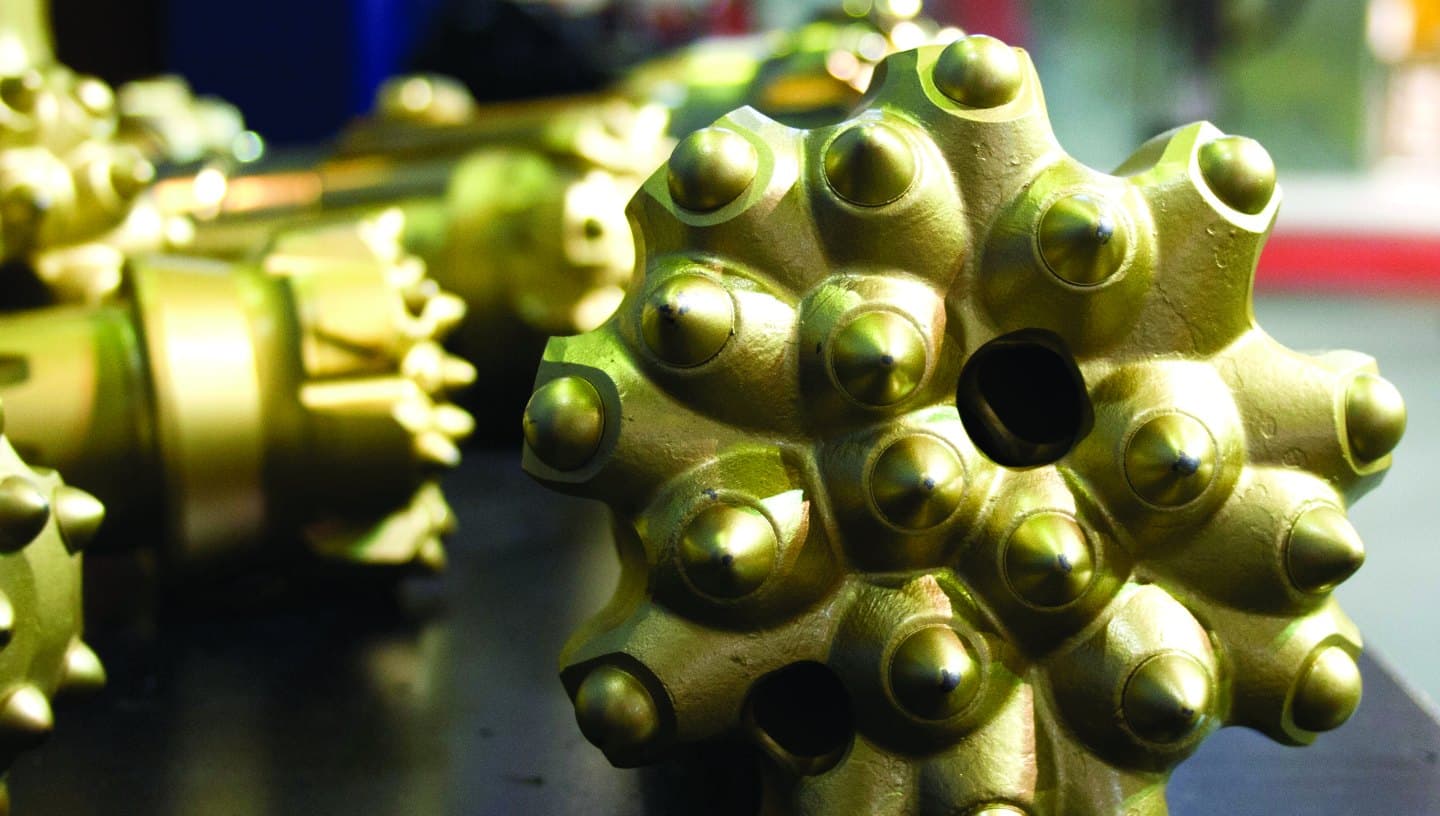
DTH button bits
The hammer sits directly behind the bit, driven by compressed air — the method for larger holes in hard rock. Every blow lands on the buttons.
AP/02
Top-hammer bits, drill rods & cross bits
The hammer works at the top of the drill string and its energy travels down the rods — small-diameter holes in hard rock.
AP/03
Rock roller bits
Rotation and pull-down force let the inserts crush and spall the rock — large holes in soft to medium-hard ground.
AP/04
Coal & stone auger tips
Cutting tips for augers drilling through coal seams and stone.
AP/05
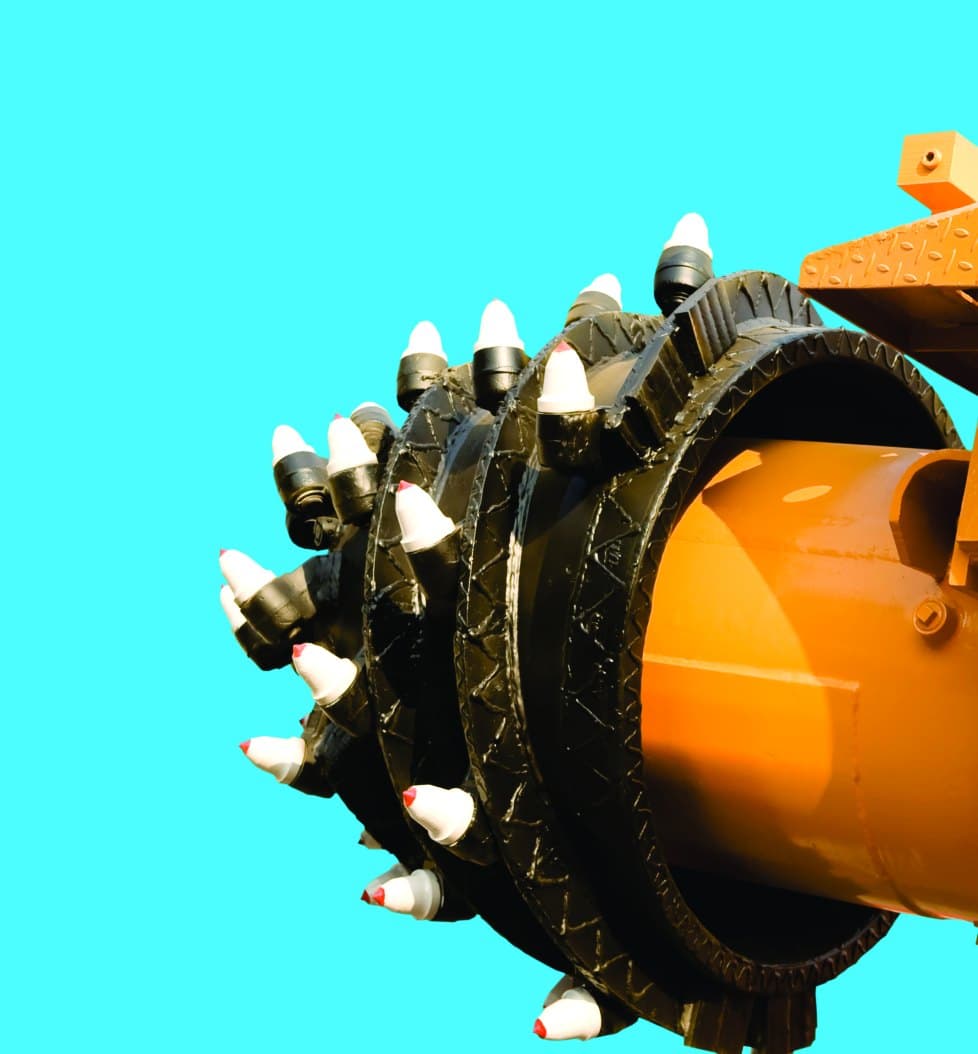
Bucket-wheel & trencher excavation
Tips for continuous excavators and trenchers, where tools cut and scrape rather than hammer.
AP/06
Octagonal & square inserts
Inserts for drilling and excavation tools beyond the round-button range.
02 — Shape selection
Pick the shape for the rock, not the catalogue.
Button shape trades penetration against survival. Pointed profiles drill fastest in softer ground; domed and flat profiles outlast them where rock is hard, abrasive or broken.
Faster ← → Tougher
Ballistic · Conical · Spherical
CC · CD
Ballistic
The fastest penetration in soft-to-medium, low-abrasion rock. The pointed profile bites deep — and is the most exposed to breakage in hard ground.
Rock: Soft → Medium
Penetration
Robustness
CE · CF
Conical
An aggressive profile with more support behind the tip — a balance of penetration and life for medium to medium-hard formations.
Rock: Medium → Hard
Penetration
Robustness
CG · CH
Chisel / side-wedged
A wedge that cuts and scrapes rather than crushes — for roller-cone bits, auger tips and excavation teeth in softer, less abrasive ground.
Rock: Soft → Medium
Penetration
Robustness
CA · CB
Spherical
The survivor. A full dome spreads impact and resists chipping in hard, abrasive or fractured rock — at a slightly lower penetration rate.
Rock: Hard → Very hard / abrasive
Penetration
Robustness
CI
Flat
Wear protection rather than penetration — gauge and body protection, and flat-face work in very hard, abrasive ground.
Rock: Hard → Very hard / abrasive
Penetration
Robustness
Rule-of-thumb guidance from rock-drilling practice. The right button also depends on the bit design, the rig, feed and flushing — tell us your formation and current bit life and we'll recommend a shape and grade.
03 — Standard range
96 sizes. Every dimension published.
Nine button types, each with its full dimension table — so you can match your bit drawing before you ask for a quote.
| No. | D | H | h | R | e | α | θ |
|---|---|---|---|---|---|---|---|
| 1 | 10.8 | 21 | 6 | 8.4 | 2.1 | 20 | 15° |
| 2 | 12.2 | 26 | 6 | 8.74 | 2.5 | 20 | 15° |
| 3 | 14.8 | 21 | 6 | 8.4 | 2.5 | 15 | 15° |
| 4 | 16.3 | 21 | 6 | 8.4 | 2.3 | 20 | 15° |
| 5 | 16.8 | 21 | 6 | 8.74 | 2.3 | 15 | 15° |
| 6 | 16.8 | 26 | 6 | 8.74 | 2.3 | 15 | 15° |
| 7 | 18.3 | 26 | 6 | 8.74 | 2.1 | 15 | 15° |
| 8 | 20.3 | 26 | 6 | 8.4 | 2.1 | 15 | 15° |
| No. | D | H | h | R | e | α |
|---|---|---|---|---|---|---|
| 1 | 4.860 | 5.10 | 0.950 | 3.600 | 1.000 | 1.000 |
| 2 | 6.468 | 5.25 | 0.700 | 7.700 | 1.500 | 1.500 |
| 3 | 8.017 | 6.75 | 1.400 | 6.400 | 1.500 | 1.500 |
| 4 | 9.565 | 9.53 | 3.360 | 5.100 | 1.750 | 1.750 |
| 5 | 10.070 | 10.20 | 3.150 | 5.600 | 1.750 | 1.750 |
| 6 | 11.190 | 10.05 | 1.420 | 11.700 | 1.500 | 1.500 |
| 7 | 12.790 | 9.20 | 2.500 | 10.000 | 1.500 | 1.500 |
| 8 | 13.700 | 19.35 | 5.560 | 7.000 | 2.250 | 2.250 |
| 9 | 14.300 | 22.35 | 5.700 | 7.300 | 2.250 | 2.250 |
| 10 | 15.950 | 21.00 | 7.200 | 8.000 | 1.500 | 1.500 |
| 11 | 16.700 | 25.40 | 6.550 | 8.600 | 2.250 | 2.250 |
| 12 | 17.000 | 26.00 | 6.520 | 8.800 | 2.250 | 2.250 |
| 13 | 18.000 | 25.00 | 7.290 | 9.200 | 2.250 | 2.250 |
| 14 | 19.140 | 13.23 | 3.250 | 16.400 | 2.150 | 2.150 |
| 15 | 25.475 | 28.37 | 10.590 | 13.000 | 2.150 | 2.150 |
| No. | D | H | h | R1 | R2 | α | θ |
|---|---|---|---|---|---|---|---|
| 1 | 6.01 | 10.2 | 3.4 | 2.20 | 4.00 | 25° | 15° |
| 2 | 7.05 | 9.8 | 3.9 | 2.20 | 8.50 | 25° | 15° |
| 3 | 8.05 | 11.1 | 4.45 | 2.50 | 9.80 | 25° | 15° |
| 4 | 9.1 | 11.45 | 5 | 2.80 | 11.00 | 25° | 15° |
| 5 | 10.05 | 13.5 | 5.5 | 3.30 | 12.00 | 25° | 15° |
| 6 | 11.045 | 18 | 6.8 | 3.30 | 12.00 | 25° | 15° |
| 7 | 12.01 | 19 | 7 | 3.50 | 13.00 | 25° | 15° |
| 8 | 13.01 | 20 | 7.2 | 3.50 | 15.50 | 25° | 15° |
| 9 | 14.01 | 22 | 7.7 | 3.80 | 16.70 | 25° | 15° |
| 10 | 16.01 | 26 | 11 | 5.00 | 44.50 | 25° | 15° |
| No. | D | H | h | R1 | R2 | α | e |
|---|---|---|---|---|---|---|---|
| 1 | 9.1 | 16 | 5 | 2.40 | 11.00 | 25° | 2 |
| 2 | 10 | 17 | 5.5 | 3.00 | 12.00 | 25° | 2 |
| 3 | 11 | 19 | 6.7 | 3.00 | 12.00 | 25° | 2 |
| 4 | 12 | 20 | 7 | 3.20 | 13.00 | 25° | 2 |
| 5 | 13 | 21 | 7.2 | 3.30 | 15.50 | 25° | 2 |
| 6 | 14 | 22 | 7.7 | 3.50 | 16.70 | 25° | 2 |
| 7 | 16 | 25 | 10 | 4.50 | 20.00 | 25° | 2.2 |
| 8 | 18 | 27 | 10.5 | 6.50 | 28.00 | 25° | 2.2 |
| 9 | 21.5 | 27.85 | 11.35 | 2.00 | 50.00 | 25° | 1.5 |
| 10 | 24.2 | 33 | 13.5 | 2.50 | 50.00 | 25° | 1.5 |
| 11 | 26.5 | 27 | 10.5 | 6.5 | 28 | 25° | 2.2 |
| No. | D | H | h | R | e | α | θ |
|---|---|---|---|---|---|---|---|
| 1 | 7.02 | 10.5 | 3.5 | 2.50 | 1.50 | 25° | 15° |
| 2 | 8.02 | 11.5 | 4.05 | 3.00 | 1.80 | 25° | 15° |
| 3 | 9.02 | 12.6 | 4.55 | 3.00 | 1.90 | 25° | 15° |
| 4 | 10.04 | 14.25 | 6.15 | 2.00 | 2.10 | 25° | 15° |
| 5 | 11.04 | 17.9 | 6.51 | 2.50 | 2.30 | 25° | 15° |
| 6 | 13.01 | 19.9 | 8 | 4.00 | 2.20 | 25° | 15° |
| 7 | 15.01 | 22 | 9.05 | 5.00 | 2.70 | 25° | 15° |
| 8 | 20.69 | 28.25 | 10.92 | 7.90 | 3.70 | 25° | 15° |
| 9 | 23.925 | 42.7 | 18.45 | 7.00 | 4.30 | 25° | 15° |
| 10 | 28.6 | 44.4 | 22.25 | 7.60 | 4.30 | 25° | 15° |
| No. | D | H | h | R | e | α |
|---|---|---|---|---|---|---|
| 1 | 5 | 7.2 | 3.8 | 0.50 | 0.80 | 45° |
| 2 | 8.03 | 9.4 | 4.05 | 2.90 | 1.50 | 45° |
| 3 | 9.07 | 10.5 | 4 | 4.30 | 1.30 | 45° |
| 4 | 10.07 | 12.9 | 5.3 | 4.00 | 1.60 | 45° |
| 5 | 11.07 | 15.5 | 5.5 | 4.50 | 1.60 | 45° |
| 6 | 12.07 | 14.5 | 6 | 5.00 | 1.60 | 45° |
| 7 | 13.07 | 17.1 | 6.75 | 4.40 | 1.60 | 45° |
| 8 | 14.335 | 20.6 | 9.5 | 4.30 | 1.50 | 45° |
| 9 | 15.55 | 20.3 | 9.2 | 6.60 | 1.50 | 45° |
| 10 | 18.2 | 26.5 | 10.7 | 2.00 | 1.25 | 45° |
| 11 | 19.013 | 26.65 | 12.4 | 5.2 | 2.1 | 45° |
| No. | D | H | h | α | γ | θ | e |
|---|---|---|---|---|---|---|---|
| 1 | 11.07 | 15.3 | 5.3 | 20° | 20° | 25° | 1.5 |
| 2 | 13.07 | 17.5 | 6.5 | 20° | 20° | 25° | 1.5 |
| 3 | 14.335 | 19.85 | 9.5 | 20° | 20° | 25° | 1.5 |
| 4 | 15.95 | 21.8 | 10.7 | 17.5° | 17.5° | 25° | 1.5 |
| 5 | 19.125 | 31.9 | 15.25 | 15° | 15° | 25° | 2.3 |
| 6 | 20.07 | 26 | 10 | 22° | 22° | 25° | 2 |
| 7 | 22.07 | 31 | 13 | 20° | 20° | 25° | 2 |
| No. | D | H | h | α | θ | e | β |
|---|---|---|---|---|---|---|---|
| 1 | 6.43 | 7.5 | 3 | 22° | 80° | 1.5 | 45° |
| 2 | 8.035 | 10.55 | 5.23 | 25° | 59° | 2 | 45° |
| 3 | 9.635 | 12.7 | 6.35 | 19.5° | 63.5° | 1.9 | 45° |
| 4 | 10.07 | 14 | 6 | 15° | 80° | 1.2 | 45° |
| 5 | 11.07 | 12.4 | 4.4 | 15° | 91.5° | 2.5 | 45° |
| 6 | 12.07 | 15 | 7 | 15° | 90° | 1.2 | 45° |
| 7 | 13.07 | 16.5 | 7.5 | 20° | 62.7° | 3.5 | 45° |
| 8 | 14.07 | 20.1 | 9.1 | 20° | 58° | 4.2 | 45° |
| 9 | 15.95 | 20 | 9.7 | 18° | 72.5° | 3.2 | 45° |
| 10 | 16.07 | 25 | 12 | 13° | 52° | 3.5 | 45° |
| 11 | 19.125 | 26.65 | 12.4 | 22° | 64° | 4.2 | 45° |
| 12 | 22.3 | 33 | 16.5 | 18° | 58° | 4.8 | 45° |
| 13 | 25.47 | 50.8 | 25.4 | 11° | 47° | 2.8 | 45° |
| No. | D | H | h | θ | e | α |
|---|---|---|---|---|---|---|
| 1 | 4.86 | 4.2 | 0.6 | 45° | 0.80 | 15° |
| 2 | 6.07 | 4.8 | 0.8 | 45° | 1.20 | 15° |
| 3 | 8.07 | 5 | 0.6 | 45° | 1.20 | 15° |
| 4 | 9.615 | 8.03 | 0.6 | 45° | 1.5 | 15° |
| 5 | 10.07 | 8 | 1.5 | 45° | 1.50 | 15° |
| 6 | 11.19 | 8.74 | 1.5 | 45° | 1.40 | 15° |
| 7 | 12.07 | 10 | 1.5 | 45° | 1.50 | 15° |
| 8 | 13.6 | 17.85 | 1.8 | 45° | 1.80 | 15° |
| 9 | 15.95 | 10.55 | 1.5 | 45° | 1.50 | 15° |
| 10 | 16.7 | 25 | 3 | 45° | 3.00 | 15° |
| 11 | 25.475 | 19.05 | 2.1 | 45° | 2.1 | 15° |
All dimensions in mm · D diameter · H overall height · h head height · R radii · e and angles α β γ θ as dimensioned on our brochure drawing for each type — ask for the drawing of any size.
04 — Mining grades
A grade ladder from 6% to 14% cobalt.
Low-cobalt grades hold their profile longest in abrasive rock. As cobalt rises, hardness falls and rupture strength climbs — the button gives up some wear life to survive heavier impact.
↑ Wear resistance
↓ Impact toughness
| Grade | Cobalt % | Hardness, HRA | TRS min, MPa | Density, g/cm³ |
|---|---|---|---|---|
| CIW 06 | 6 | 90.0–91.0 | 2,400 | 14.9–15.0 |
| CIH 06 | 6 | 89.0–91.0 | 2,450 | 14.9–15.0 |
| CID 08 | 8 | 88.0–89.0 | 2,550 | 14.70–14.80 |
| CID 10 | 9.5 | 87.5–88.5 | 2,600 | 14.50–14.60 |
| CIH 10 | 9.5 | 86.0–89.0 | 2,650 | 14.50–14.60 |
| CIR 11 | 11 | 88.0–89.8 | 2,650 | 14.40–14.50 |
| CID 14 | 14 | 85.8–86.8 | 2,800 | 14.08–14.18 |
| CIR 14 | 14 | 86.0–89.0 | 2,850 | 14.08–14.18 |
| CIH 14 | 14 | 86.5–89.0 | 2,850 | 14.08–14.18 |
Published values from our mining-buttons brochure · hardness bars on an 85–91.5 HRA scale
All grades →05 — Field guide
Read the wear before you reorder.
A worn button tells you whether the rock, the rig or the grade is winning. What to look for — and what to change.
| What you see | Likely cause | What to do |
|---|---|---|
| Flat wear on the buttons; penetration slowing | Normal abrasive wear | Regrind before the wear flat reaches about one-third of the button diameter (some bit makers set 25%). Leave a small flat — don't grind away button height. |
| Fine crazing on the button surface ("snakeskin") | Heat from friction — often in less abrasive rock, or with poor flushing | Regrind early to remove the cracked layer, and check flushing. Left alone, the cracking breaks the button up — even before the wear flat looks large. |
| Chipped or broken buttons | Impact overload — hard or fractured ground, or excessive feed | Move to a more robust shape (spherical) or a tougher, higher-cobalt grade, and check the feed force. |
| Gauge buttons wearing fastest; hole diameter shrinking | The outer row does the most work in abrasive rock | Use robust buttons on the gauge, consider a harder gauge grade, and keep to a regrind schedule so the hole stays to size. |
| Buttons lost from the bit | Loss of grip — steel worn away around the buttons, or a poor fit in the bit body | Retire bits with eroded bodies, and check the button-to-hole fit with your bit maker. |
General guidance from rock-drilling practice. Your bit manufacturer's regrind limits always take precedence.
06 — 2026–27
More rock to move. Less room for supply risk.
India's mining output keeps climbing — and the tungsten behind every carbide button has become a strategic material.
1.31 bn t
India's projected coal production, FY 2026-27
The government's all-India projection — with Coal India targeting one billion tonnes of it. Every tonne starts with a drilled and blasted hole.
₹34,300 cr
National Critical Mineral Mission
A seven-year outlay, launched in 2025, for exploration, mining and processing of critical minerals — exploration that begins with drilling.
Feb 2025
Tungsten export licensing in China
Tungsten and its intermediates came under export licensing — making a domestic, powder-to-button source a supply hedge for Indian drillers.
07 — Questions
Asked by drillers and buyers.
Shapes, grades, regrinding and how to order.
Q/01What shapes of tungsten carbide mining buttons do you make?
Five shapes in nine types: spherical (CA, CB), ballistic (CC, CD), conical (CE, CF), side-wedged or chisel (CG, CH) and flat (CI) — 96 standard sizes with diameters from 4.86 mm to 28.6 mm. We also make octagonal and square inserts and coal and stone auger tips.
Q/02Which carbide grade should I use for mining buttons?
Our mining series runs from 6% to 14% cobalt. Lower-cobalt grades hold their shape longer in abrasive rock; higher-cobalt grades resist chipping and fracture under heavy impact. CID08 and CID10 are our general-purpose grades for mining, rock drilling and boring. Tell us the formation, the rig and your current bit life and we'll recommend a grade.
Q/03Which button shape drills fastest?
Ballistic and conical buttons penetrate fastest in soft-to-medium, less abrasive rock. Spherical buttons survive best in hard, abrasive or fractured ground, at a slightly lower penetration rate. Chisel buttons suit specific cutting actions such as roller and auger tools.
Q/04Where are your mining inserts manufactured?
At our plant in MIDC Ambad, Nashik, Maharashtra. We run the full chain in-house — from tungsten metal powder through pressing, sintering and finishing — with an annual capacity of 25 MT.
Q/05When should button bits be reground?
As a rule of thumb, before the wear flat on the buttons reaches about one-third of the button diameter — some bit makers set the limit nearer 25%. Regrind earlier if you see fine 'snakeskin' cracking on the buttons, which comes from heat and will break the button up if left. Your bit manufacturer's limits always take precedence.
Q/06What do you need from me to quote mining buttons?
The button type and size from our tables (for example, type CB, size 11), or your drawing; the quantity; and either the grade you use today or the rock, rig and bit you drill with, so we can recommend one.
Q/07Do you make complete drill bits?
No — we make the tungsten carbide: buttons and inserts supplied to drill-bit and tool makers, who fit them into DTH bits, roller bits, cross bits and augers. If you make or rebuild bits, our 96 standard button sizes and mining grades are on this page.
Q/08Can I order a button size that isn't in your tables?
Send us the drawing. Our 96 standard sizes cover most bit designs; for anything else we'll confirm whether we can make it and quote it.
Further reading
RFQ — 24 h engineering response
Send us your
hardest problem.
Share a drawing, a failing part, or a duty cycle. Our application engineers reply within 24 hours with DFM feedback, a grade recommendation, and a technical quote.
Trusted by Bosch · HAL · Atlas Copco · SECO · Jindal Stainless and more